
Benchmark report
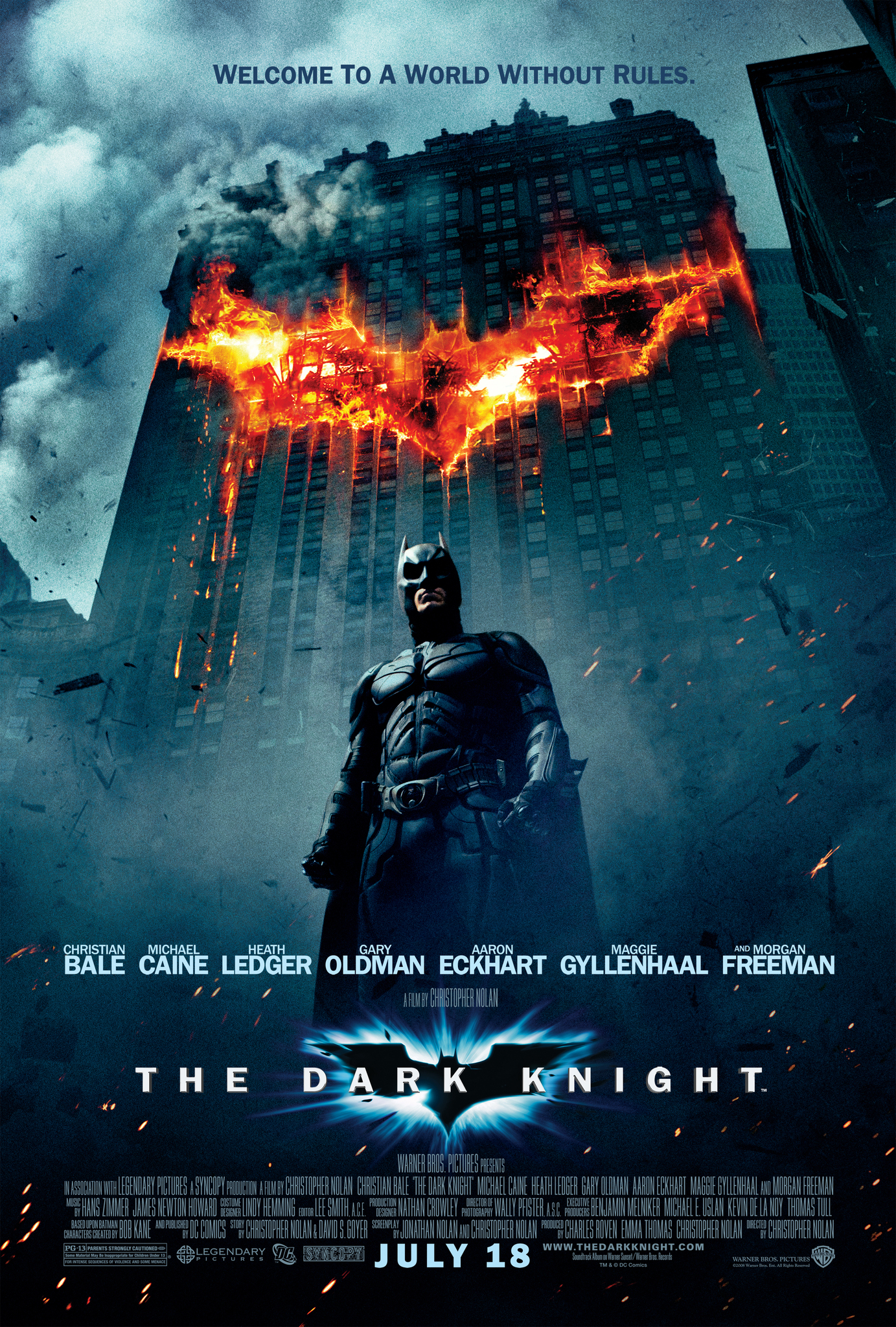
Batman The Dark Knight
English · Christopher Nolan · 2008 · Action
Our analysis of a produced screenplay. The script is not hosted, readable or downloadable here.
Masterpiece
An exceptionally constructed crime-thriller in superhero clothing, driven by a thematically potent antagonist and a genuine tragic arc. Structure, dialogue and theme are top-tier; only Rachel is somewhat underserved. This is a produced, award-winning screenplay rather than original submission material.
Iconic escalation: an anarchist antagonist who forces a moral reckoning rather than pursuing money. The dual-boat social experiment and Dent's fall are conceptually rich and airtight.
Within the superhero genre this reframes the villain as an agent of chaos and interrogates heroism itself—unusually thematic for the form, though it is a franchise entry.
Massive commercial property with proven blockbuster appeal, strong roles and set pieces.
Complex interlocking plotlines (Dent, Gordon, Joker, mob) escalate cleanly toward the twin climaxes of the ferries and Dent's turn. Very controlled despite scope.
Dent's arc from white knight to Two-Face is tragic and earned; the Joker is a vivid force; Wayne/Alfred/Fox provide grounding. Rachel is thinner but functional.
Memorable, quotable lines ('you either die a hero...'), the Joker's monologues land, Alfred's Burma parable is a standout.
Rachel's death and the intercut choice, Gordon's fake death, the ferry standoff and Dent's fall all deliver genuine stakes and feeling.
Order vs chaos, the cost of heroism, and the noble lie are woven through every subplot and pay off in the final voiceover.
Assured action description, clean intercutting, escalating tension. Occasional typos aside, this is polished professional screenwriting.
Read this first
What a producer would take away in thirty seconds.
This is a dense, multi-strand crime epic that nevertheless tracks a classical three-act spine underneath its sprawl: a heist prologue establishes tone and stakes, a long investigative Act Two escalates through the Hong Kong extraction and the RICO gambit into the Joker's campaign of chaos, and a brutal Act Three collapses Harvey Dent's arc into Two-Face while Batman absorbs the moral cost. The structure is unusually ambitious for the format — juggling Gordon, Dent, Lau, the mob, and the Joker as near-equal engines — but the turns land where they need to: the false-confession midpoint, Rachel's death as the low point, and Batman's self-sacrificing frame-up as the Act Three engine that resolves theme rather than plot alone.
Why this score
The score reflects a script whose structural machinery is nearly invisible because it's so well integrated with theme and character — the beats exist, they're just disguised as plot escalations (the Hong Kong extraction functions as Act One's plan-lock, the Prewitt Building assault functions as the false climax) rather than sitting in obvious slots. The only reason this isn't a flawless 100 on structure alone is that the sheer number of parallel plots (Lau/mob financials, MCU procedural, Dent/Rachel romance, Joker's philosophical war) means a few connective beats — B Story reaffirmation, a clean Act Two midpoint 'break' — are submerged rather than dramatized, asking a lot of an audience/reader to track causality across pages 28-70.
Do this next
Ranked by what moves the script most. Start at one.
The single biggest lever
The single highest-value move left on the table is tightening the legal-procedural exposition (RICO explanation, bank warrant logistics, holding-cell decisions clustered p.38-41) so that plot mechanics are dramatized through character behavior rather than stated aloud — everything else in the script already trusts the audience to infer theme and consequence, and this pocket is the one place dialogue does the work action or implication could do instead.
- 01Character/Dialoguepp. 38–41medium impact
Compress the RICO explanation into fewer lines, or distribute the exposition into action beats (e.g., show Dent already drafting the charges before Rachel articulates the legal theory) so we infer the plan rather than being told it twice.
Why: The RICO/interrogation-room exposition stretch relies on characters explaining legal mechanics to each other in flat question-answer dialogue.
Payoff: Tightens pacing through a dense plot stretch and keeps Dent and Rachel's dialogue characterful rather than functional.
- 02Characterpp. 20–23medium impact
Give Rachel one clear proactive beat earlier in the script — a decision she makes unprompted by either man — so her later choice (the letter, p.95-96) feels like a culmination of established agency rather than a reveal.
Why: Rachel's characterization leans heavily on reacting to Wayne and Dent rather than driving scenes with her own agenda.
Payoff: Makes her death and the posthumous letter hit harder because we've seen her as an actor in her own story, not just a prize.
- 03Dialoguep. 67low impact
Trim Dent's dialogue in this scene so the coin's symbolic weight is left to accumulate silently, saving the explicit philosophy for Two-Face's climax speeches.
Why: The coin-flip interrogation slightly over-explains the coin's meaning right before the device is used far more powerfully later.
Payoff: Avoids diminishing returns on the coin motif and makes its final use (p.130-136) feel like a bigger reveal rather than a reiteration.
- 04Structurepp. 94–96low impact
Consider trimming a beat or two of the voiceover montage to keep forward pressure toward Dent's psychological break, which is the more urgent throughline at this point.
Why: The Rachel's-letter sequence (voiceover intercut with Alfred, Batman, Dent) is emotionally strong but risks slightly softening the blow of Dent's turn by spending time on Wayne's grief right before Dent's descent needs momentum.
Payoff: Keeps the back half moving toward the ferry/finale climax without a lull in momentum.
- 05Dialoguep. 41low impact
Fold these into action description or combine with a character beat (Gordon's exhaustion, distrust of colleagues) so even functional lines carry characterization.
Why: Some short procedural Gordon lines ('He can't go to County...') function purely as plot logistics.
Payoff: Every line does double duty, reinforcing Gordon's paranoia about leaks established elsewhere.
Structure
Where the act breaks actually fall, not where a template says they should.
Act One
pp. 1–27The bank heist (pp1-4) introduces the Joker's method and cruelty before he's even named. Gordon, Batman, Dent, and Rachel are set up in parallel scenes establishing the marked-bills investigation, Dent's crusading DA persona, and the Wayne/Rachel/Dent triangle. The mob's crisis (Lau's proposal, p24-25) and the Joker's pitch to kill Batman (p26-27) close the act by declaring the film's true engine: not cops vs mob, but Batman vs the Joker.
The Joker addresses the assembled crime bosses and proposes killing Batman for half their money (p26-27) — the mob's fear becomes the Joker's opportunity, reframing the entire conflict.
The heist opening doing triple duty — hooking the reader, characterizing the Joker via action rather than exposition, and hiding the mystery of 'who is the Joker' — is efficient plotting; you don't waste pages on throat-clearing before the antagonist is operating.
Act Two-A
pp. 28–71Wayne/Fox extract Lau from Hong Kong (pp29-40), enabling the RICO mass-arrest at the courthouse (pp41-43). The mob, cornered, turns fully to the Joker, who escalates through Loeb's poisoning, Surrillo's car bomb, and the penthouse assault on Dent's fundraiser (pp44-54). Dent's public 'I am the Batman' declaration (p71) functions as the midpoint reversal — a decoy sacrifice that inverts the expected hero/villain positions.
Dent's false confession at the press conference (p70-71) — the plot's central deception, escalating the personal stakes for every character simultaneously.
This section runs long relative to a 110-page-equivalent structure, but the parallel Joker-escalation and mob-collapse plots earn the extra real estate because each new atrocity (Loeb, Surrillo, the party attack) raises stakes rather than repeating them.
Act Two-B
pp. 72–93The prisoner-convoy ambush and capture of the Joker (pp73-81) look like a victory, but his interrogation of Batman (pp84-89) reveals he orchestrated his own capture to bait Dent and Rachel into a trap. The kidnapping, Dent's rescue, and Rachel's death (pp88-93) constitute the true 'all is lost' turn for the film.
Rachel's death (p93) — the Joker's manipulation succeeds completely; Batman saves the wrong hostage, and Dent's transformation begins.
Positioning the interrogation scene as a false Act Two climax (Batman appears to have won by capturing the Joker) before immediately undercutting it with Rachel's death is a strong structural sleight of hand — it disguises the true midpoint/low-point boundary.
Act Three
pp. 94–140Dent's disfigurement and descent into Two-Face runs parallel to the Joker's citywide terror campaign (Reese's threat, the hospital bombing, the ferry dilemma, pp94-125). The climax converges all threads: Batman stops the Joker at the Prewitt Building while Gordon's family is held hostage by Dent, ending in Dent's death and Batman's decision to take the blame to preserve Gotham's faith in Dent's legacy.
Dent's death and Batman's choice to be blamed for the murders (pp135-138) — resolves the theme (necessary lies vs corrosive truth) rather than simply the plot.
The ferry sequence functioning as a thematic climax running concurrent with, rather than subordinate to, the Dent/Gordon rooftop confrontation is the script's most sophisticated structural move — two climaxes cross-cut so neither one has to carry the whole thematic weight alone.
Midpoint · page 71
Harvey Dent publicly declares 'I am the Batman' and is arrested, offering himself as a decoy to draw out the Joker.
It's a false-victory midpoint that inverts the expected trajectory — instead of Batman gaining ground, he lets an innocent man absorb the danger meant for him, which directly sets up the moral corruption/sacrifice theme paid off at the climax. It also converts the Dent/Rachel/Wayne triangle into a life-or-death mechanism rather than a subplot, which is efficient structural economy.
Beat sheet
Where the beats land against where they conventionally fall. A deviation isn't automatically a fault.
88/100
Structure adherence
The beats are all present but frequently fused with plot mechanics from other strands (mob financials, Two-Face genesis) rather than isolated as pure structural beats — this is a deliberate genre choice for a multi-plot thriller and mostly succeeds, though it makes a few beats (B Story, Break into Three) harder to isolate on the page.
| Beat | Expected | Actual | Quality |
|---|---|---|---|
| Opening ImageThe burning bat-symbol dissolving into the bank heist (p1) sets tone, genre and villain method in one unbroken sequence — about as strong an opening image as the format allows. | p.1 | p.1 | 95 |
| Theme StatedEngel's news debate over vigilantism (pp5-6) plants the 'masked hero vs. accountable law' theme early, though it's delivered as media noise rather than character conviction — Dent's Roman-senate speech at dinner (p22-23) is the sharper, more memorable theme statement and could arguably be the primary marker. | p.6 | p.6 | 78 |
| SetupWorld and relationships (Gordon/Ramirez, Dent/Rachel/Wayne, Fox, Alfred, Lau) are established through pages 5-21; slightly later than formula but justified by the size of the ensemble. | p.13 | p.21 | 85 |
| CatalystThe Joker's pitch to the mob bosses to kill Batman (p26-27) is the true catalyst — it converts a procedural mob-money plot into the Joker/Batman war that drives the rest of the film. | p.15 | p.27 | 90 |
| DebateWayne and Fox's brief exchange about whether to pursue Lau (p29-30) is thin as a 'debate' beat — the hesitation is mostly procedural (how, not whether) rather than a real moral debate, since Batman's resolve is never in question here. | p.25 | p.29 | 75 |
| Break into TwoThe Hong Kong extraction and Lau's delivery to MCU (pp33-40) commits the story to the RICO gambit — a clear, active choice that locks in Act Two's engine. | p.32 | p.40 | 88 |
| B StoryThe Wayne/Dent/Rachel fundraiser (pp43-48) carries the emotional B-story, but it's interrupted by the Joker's assault before it can breathe — the romantic triangle is more often used as leverage for the plot than developed for its own sake. | p.38 | p.43 | 70 |
| Fun and GamesThe Loeb poisoning, Surrillo's car bomb, and the penthouse invasion (pp48-54) deliver the 'promise of the premise' — the Joker doing exactly the escalating chaos the film promised — with real inventiveness in each set-piece. | p.38 | p.54 | 90 |
| MidpointSee midpoint analysis — a false-victory reversal that reorients the stakes onto Dent rather than resolving anything. | p.70 | p.71 | 92 |
| Bad Guys Close InThe convoy ambush and Joker's capture (pp73-81) initially read as a win, but the interrogation scene (pp84-89) reveals it was the trap closing in on Batman, Dent, and Rachel — a well-executed inversion of the usual 'things get worse' beat. | p.83 | p.81 | 85 |
| All Is LostRachel's death (p93) is unambiguous and devastating, and it's the hinge the entire third act pivots on — the strongest single beat in the script. | p.95 | p.93 | 95 |
| Dark Night of the SoulWayne's grief and Alfred's Burma monologue (pp96-97), followed by Dent's hospital-room reveal and vow of vengeance (pp98-99), together form an unusually well-earned dark night, spread across two characters instead of one. | p.102 | p.97 | 88 |
| Break into ThreeFox's activation of the sonar-phone network (pp112-114) is the mechanical Act Three tool-up, but the true break into three is arguably Dent's murder of Wuertz and Ramirez's informant (pp111-120), which is where the plot commits to Two-Face as an active antagonist alongside the Joker. | p.108 | p.112 | 80 |
| FinaleThe ferry dilemma and Prewitt Building assault (pp121-131) cross-cut into the Gordon-family hostage climax (pp132-136) — two simultaneous set-pieces resolving the film's two thematic questions (do ordinary people become monsters? does Gotham need a lie?) in parallel. | p.108 | p.121 | 93 |
| Final ImageBatman fleeing into the dark as Gordon narrates the 'Dark Knight' voiceover (pp136-138) mirrors and inverts the opening image — from a villain emerging out of fire to a hero disappearing into shadow, a clean bookend. | p.140 | p.138 | 90 |
Pacing
relentless
The film builds tension in escalating waves, each act ending on a bigger detonation than the last, with only brief valleys for character work.
slow · pp. 17–33
The courtroom/dinner/boardroom stretch trades momentum for table-setting dialogue right after two propulsive action sequences.
Fix: Intercut one of these scenes with a Joker or mob beat happening simultaneously to keep tension alive under the exposition.
rushed · pp. 43–53
The Hong Kong extraction compresses infiltration, capture and extraction into a tight sprint that can feel like a checklist of cool gadgets rather than earned suspense.
Fix: Give Lau one more beat of paranoia or near-discovery before Batman breaches, so the payoff lands harder.
Conflict
How hard the opposing force presses — a different curve from pacing.
Pressure escalates from street-level mob threats to a citywide moral trap, with the Joker's psychological attacks pressing harder than any physical fight.
Peak · page 130
Two-Face holds Gordon's son at gunpoint over a coin flip, forcing Batman to choose between his code and the boy's life.
Protagonist arc
Bruce Wayne / Batman · arc 78/100
Batman's arc moves from confident vigilante to a man who sacrifices his reputation entirely, ending lower on public standing but higher on thematic completion.
Emotional rhythm
What the audience feels, page by page — not what the characters feel.
The film moves the audience from giddy heist-thriller pleasure into genuine moral horror, ending on somber, hard-won awe rather than triumph.
Characters
Want, need and flaw — and whether the script knows the difference.
Bruce Wayne / Batman
ProtagonistWants
To end mob rule in Gotham and eventually retire the Batman persona so he can have a normal life with Rachel
Needs
To accept that being a symbol sometimes requires sacrificing his own reputation and happiness for the greater good
Flaw
His absolutism about his 'one rule' and his belief he can control chaos through force and technology, refusing to accept limits (p.13-14 with Alfred)
Wayne's arc completes with the choice to become 'the villain' at the end, taking Dent's crimes as his own — a genuine sacrifice of identity that pays off the Alfred scene on p.13-14 about limits.
Harvey Dent / Two-Face
Tragic antagonist / dark mirrorWants
To clean up Gotham through legitimate legal means as the 'White Knight' DA
Needs
To confront that his faith in fairness and control (embodied by the coin) is an illusion he only discovers once it's used against him
Flaw
His hidden reliance on chance even when he claims to 'make his own luck' (established p.14-15 with the coin, paid off tragically p.130-136)
The best-executed arc in the script — the coin is planted early as a charming quirk and becomes the mechanism of his complete moral inversion. Rare screenwriting discipline.
The Joker
Antagonist / thematic engineWants
To prove that civilization's moral codes are a sham and that anyone can be broken
Needs
Arguably none — he is designed as an agent without a conventional arc, which is the point
Flaw
None in the traditional sense; his 'flaw' is structural (no consistent backstory, contradicting scar stories p.32-33 and p.85-86) which is intentional characterization, not a script weakness
Static by design. His unpredictability is the plot engine rather than a personal journey, and the two contradictory scar monologues are a deliberate device showing he's an unreliable narrator of himself.
Lt./Commissioner Jim Gordon
Deuteragonist / moral centerWants
To dismantle organized crime and keep his family safe while working within (and around) the system
Needs
To accept complicity in the compromises that enable both Batman and, ultimately, the cover-up of Dent's crimes
Flaw
His willingness to use ends-justify-means tactics (marked bills, faking his death, lying to the public) without fully reckoning with the cost until the finale
Gordon's arc is quieter but lands at the climax when he must accept lying to the entire city as policy, mirroring Batman's choice.
Rachel Dawes
Moral touchstone / catalystWants
A stable, honest relationship and a Gotham where she doesn't have to choose between two dangerous men
Needs
To make a final, clear-eyed choice and communicate it honestly
Flaw
Emotional indecision between Wayne and Dent until it's forced by her death
Her death (offscreen, p.93) is the hinge of the entire second half, but her interiority is thin before that — she functions largely as an object of male decision-making, which is a limitation more than an error given the film's design.
Casting
Who could carry these roles. Starting points to verify — not attachments, and not endorsements.
Oscar Isaac
as Bruce Wayne / Batman
Can carry the internalized, controlled anguish the role needs opposite the more theatrical antagonist, and has the gravitas for the late-script sacrifice.
Barry Keoghan
as The Joker
Proven ability to play unpredictable, unsettling menace with dark comic rhythm without leaning on mimicry of prior performances.
Aaron Taylor-Johnson
as Harvey Dent
Has the clean-cut charisma for early Dent and the physical intensity needed for the unraveling into Two-Face.
Jeffrey Wright
as Lieutenant/Commissioner Gordon
Brings weathered moral seriousness and quiet authority that fits Gordon's exhausted-idealist throughline.
Ayo Edebiri
as Rachel Dawes
Could bring more interiority and dry wit to a role that's underwritten as scripted, giving Rachel's scenes sharper presence.
Dialogue
medium
8/100
Subtext
9/100
Voice
Dialogue is razor-precise in voice differentiation — the Joker's cadence (looping riddles, false humility, 'see') is unmistakably distinct from Dent's clipped legal certainty or Alfred's dry understatement. Subtext is strongest in the Wayne/Alfred and Dent/Rachel scenes; weakest in a handful of expository police-procedural exchanges that exist to keep the audience oriented across a very plotted structure.
Lines that land
“Why so serious?”
The Joker · p.33
Iconic because it's a genuine character tic seeded in trauma, not just a catchphrase — pays off the scar monologue in the same breath.
“You either die a hero or you live long enough to see yourself become the villain.”
Harvey Dent · p.23
Planted early as dinner-party philosophizing, this line becomes the script's thesis statement and returns literally in Batman's mouth at the climax (p.137) — a textbook example of dialogue as structural device.
“I believe that what doesn't kill you... simply makes you stranger.”
The Joker · p.4
Establishes his voice and philosophy in his very first line before we even see his face — economical characterization.
“Some men just want to watch the world burn.”
Alfred · p.57
A thesis line delivered with restraint, not spelled out further — trusts the audience.
“It's not about what I want. It's about what's fair.”
Harvey Dent · p.133
Devastating because it inverts his earlier idealism using his own vocabulary.
Lines to fix
“That's why I'm not going to leave it up to me.”
Harvey Dent · p.67
Fine on its own, but the coin-flip interrogation scene around it risks feeling like it's explaining its own metaphor slightly too much given how well the coin already speaks for itself elsewhere.
“Charge them with what?”
Gordon · p.39
Purely functional RICO-explainer dialogue; necessary but flat, sitting inside a stretch of legal exposition that leans on characters asking each other questions purely to feed the audience information.
“He can't go to County. I'll keep him here in the holding cells.”
Gordon · p.41
Serves plot logistics rather than character or subtext — one of several short procedural lines that could be trimmed or folded into action description.
Scene audit
16 scenes that decide whether this works — and whether each earns its place.
| Pg | Scene | What it does | Tension | Verdict |
|---|---|---|---|---|
| 1 | bank_heist_open | cold open establishes Joker's cunning and body count before we see his faceKills off his own crew one by one, a clean visual thesis for the character before a line of dialogue is spoken. | 85accelerates | essential |
| 7 | chechen_rooftop_dogs | establishes copycat Batmen, the Batmobile, and Scarecrow as loose thread from prior filmFun and kinetic but the copycat-vigilante idea never pays off later; feels like scene-setting for a thread that gets dropped. | 65maintains | works |
| 22 | mob_meeting_joker_pitch | Joker proposes killing Batman to the assembled crime bossesPencil trick lands the character in one image; sets the entire second-act engine (bounty, banks, Lau). | 70maintains | essential |
| 32 | joker_gambol_origin_1 | first scar-story monologue, delivered while torturing GambolEffective on its own but duplicated almost beat-for-beat with Rachel at p.53 — one of the two origin stories could be cut or shortened. | 55decelerates | trim |
| 35 | hong_kong_extraction | Batman abducts Lau to force his testimony against the mobA satisfying gadget showcase, but it's a long detour (roughly six pages) for a plot beat that could be compressed. | 60decelerates | works |
| 50 | joker_crashes_party | Joker invades Wayne's fundraiser, threatens Rachel, first Batman/Joker physical clashBest staged sequence of intimidation-into-violence in the script; the window drop caps it perfectly. | 90accelerates | essential |
| 57 | alfred_burma_speech | Alfred explains 'some men just want to watch the world burn'Slows the plot deliberately to hand the audience its thematic key before the parade attack — earns the pause. | 40decelerates | essential |
| 61 | parade_assassination | Joker's honor guard tries to kill the Mayor, Gordon appears to die protecting himStrong misdirection with the fake snipers and Gordon's 'death' pays off cleanly two scenes later. | 88accelerates | essential |
| 73 | prisoner_convoy_chase | Joker ambushes Dent's transfer convoy; Batman debuts the Bat-PodThe film's centerpiece set piece; earns its length through constant escalation and the truck-flip capture. | 95accelerates | essential |
| 85 | interrogation_room | Batman beats the captured Joker for Rachel/Dent's location while he monologues his philosophyThe script's thematic core scene — Joker's 'no rules' argument directly sets up the ferry test and Dent's fall. | 92accelerates | essential |
| 89 | rachel_dent_bomb | cross-cut rescue attempt; Batman saves Dent, Rachel dies, Dent scarredThe hinge of the entire film; the swap of Batman's target (told wrong location) is the Joker's decisive victory. | 94accelerates | essential |
| 110 | sonar_phone_ethics | Fox confronts Wayne over the mass-surveillance machine, resigns in protestNecessary ethical counterweight to the ferry climax, though it plays as a fairly static two-hander. | 45decelerates | works |
| 117 | ferry_experiment | Joker forces two boats to choose whether to kill each otherThe thesis scene of the whole script; the tension holds rather than accelerates because it's built on moral paralysis, which is the point. | 90maintains | essential |
| 129 | joker_rooftop_defeat | Batman defeats Joker, second scar-story monologue, reveals Harvey as his 'ace in the hole'The second scar-story repeats beats from p.32 almost verbatim — cut one telling and the reveal about Dent lands harder without the redundancy. | 80maintains | trim |
| 132 | dent_coinflip_finale | Two-Face holds Gordon's family hostage; Batman sacrifices Dent's reputation by taking the blameDevastating capstone that pays off the coin motif, the Burma speech, and Dent's arc in one unbroken sequence. | 93accelerates | essential |
| 137 | batman_takes_blame_ending | montage of cover-up and Gordon's closing narration defining Batman as Gotham's 'dark knight'Earns its slower, elegiac pace after two acts of escalation; the narration crystallizes the film's argument rather than just wrapping plot. | 60decelerates | essential |
What's working
Keep these. A rewrite that loses them is a worse draft.
Thematic dialogue that pays off structurally
The 'die a hero / become the villain' line (p.23) and the coin motif (introduced p.14-15) aren't just quotable — they are load-bearing structural elements that resolve in the climax, which is uncommon discipline for a script this plot-dense.
Villain characterization through contradiction, not backstory
The Joker's two different origin stories (p.32-33, p.85-86) are a genuinely sophisticated device — most scripts would either pick one 'true' backstory or leave it unaddressed; here the contradiction itself is the characterization.
Ferry sequence as pure dramatized theme
Pages 117-129 dramatize the script's moral argument (chaos vs. order, decency under pressure) entirely through action and incremental character choices rather than speeches, trusting visual storytelling.
Efficient scene-to-scene propulsion via cross-cutting
The bank heist (p.1-4), the Hong Kong extraction (p.35-38), and the finale intercutting (p.136-139) all use parallel action to compress time while keeping stakes legible — strong structural craftsmanship.
Market
Primary audience: mass
Audience
Broad four-quadrant action/thriller audience, skewing male 15-45 but with strong crossover into adult drama viewers via the Dent/Two-Face tragedy and prestige villain performance
Budget band
Tentpole (studio-scale, $150M+ range based on set-pieces: bank heist, hospital demolition, ferry siege, Hong Kong extraction, multi-vehicle convoy chase)
Trend
Evergreen — the 'elevated superhero/crime saga' lane this script effectively originates has remained commercially dominant for over a decade
Risks
- Extreme scale and stunt/practical-effects complexity drives cost and schedule risk (pp.1-10 heist, pp.74-79 convoy chase, pp.111-126 tower/ferry siege)
- Villain-centric marketing risk if the Joker casting/performance underdelivers — the entire second half hinges on that voice (pp.85-91, 112-114)
- Dark tonal ceiling caps family/youth admission (mutilation imagery p.98, fear toxin, execution-style violence throughout)
Working in its favour
- Stunt work is grounded/practical rather than CG-dependent, which is a pre-vis and insurance advantage over VFX-heavy tentpoles
- Marketing can lead with morally-driven trailer hooks (coin flip, ferry dilemma, 'why so serious') that have proven trailer-tested appeal
- Two-tier billing (movie star lead + character-actor villain) spreads bankability risk
Commercial intelligence
What a financier asks before they read page one.
Franchise potential
Sequel potentialThis is a middle chapter of an existing trilogy structure (references to an established Batman/Gordon/Rachel history, a clear open door at the end with Dent's death and Batman's exile) — on its own merits as a submission it reads as strongly sequel-capable rather than a freestanding one-off, provided the surrounding mythology is licensed/established.
Avenues
International viability
Crime, corruption, and vigilante-justice themes travel well; the Hong Kong sequence (pp.35-38) demonstrates the production already reaches outward for territory-specific appeal, but the story's moral/political framing is distinctly American (DA elections, RICO law, National Guard) which requires some localization context abroad.
Travels on
Strong markets
Needs context
Investment readiness
Moderate · Ready for packaging — script demonstrates fully realized action set-pieces, character arcs and a marketable villain hookThe commercial engine here is unusually clear for a spec-stage read: multiple distinct, marketable set-pieces (heist open, Hong Kong extraction, convoy chase, ferry dilemma) each function as a standalone trailer moment, which de-risks the marketing spend even though the production budget itself will be high.
Needs attached
Comparables
Illustrative, not claims of influence — verify before you put them in a pitch.
Heat 1995
Shares the multi-strand cops-and-criminals procedural structure and bank heist opening (pp.1-11) with a similarly grounded, unglamorous crime aesthetic
The French Connection 1971
Comparable use of practical, grounded chase choreography (the convoy sequence, pp.74-79) over stylized action
No Country for Old Men 2007
A chaos-agent antagonist who operates without conventional motive, echoed directly in the Joker's 'agent of chaos' monologue (pp.112-113)
Whose film this reads like
Michael Mann
35%International
Cold, procedural crime-thriller tone; ensemble law-enforcement/criminal parallel structure; nighttime urban photography implied throughout
William Friedkin
25%International
Grounded, practical chase sequences and a preference for tactile over spectacle-driven action (convoy chase, pp.74-79)
David Fincher
20%International
Interrogation-room psychological duels and a villain who operates as a puzzle-setter rather than a brute (pp.84-91)
Sidney Lumet
20%International
Institutional corruption and moral-compromise courtroom/political material (Dent's prosecutorial arc, pp.14-18, 42-43)
Written by AI on the draft you uploaded. Page numbers refer to that file. Comparables, directors and market notes are illustrative starting points to verify — not endorsements, and not a promise that anyone will buy it.
Analysed by SceneOne AI. A guide for creators, not a guarantee, the industry decides.
This is a sample
The same report, on your script.
Every axis, beat, pacing flag and rewrite priority you just read — written about your own draft, with your page numbers. Upload is free and your work is certified the moment it lands.