
Benchmark report
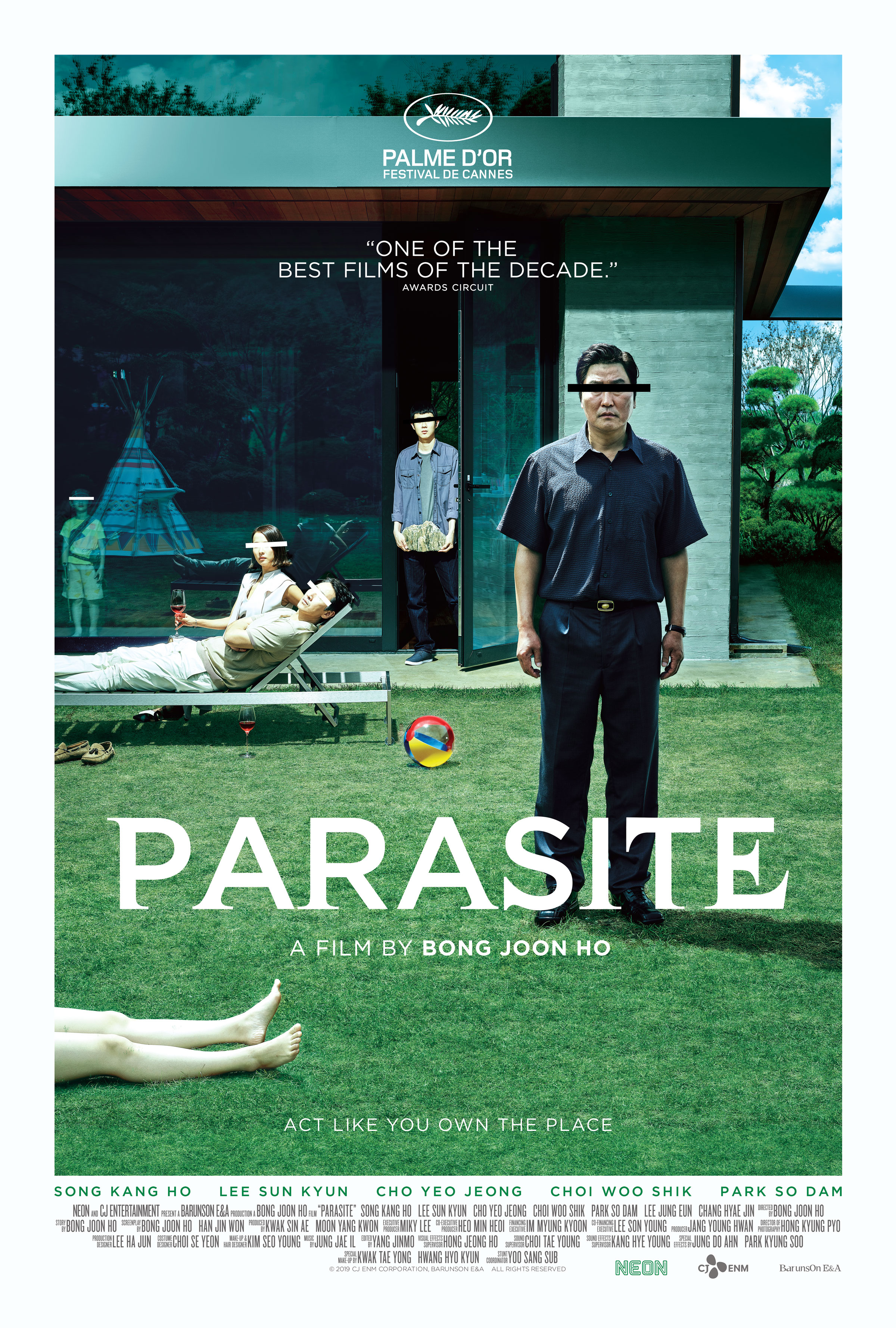
Parasite
Korean · Bong Joon Ho · 2019 · Drama
Our analysis of a produced screenplay. The script is not hosted, readable or downloadable here.
Masterpiece
A superbly constructed screenplay whose escalating infiltration premise doubles as a devastating class parable. Structure, theme, and craft operate at an elite level, with setups and payoffs interlocking flawlessly and tonal shifts handled with rare confidence. The writing itself is exceptional across nearly every axis.
A poor family infiltrating a wealthy household one job at a time, culminating in a discovery of a hidden bunker, is a brilliantly escalating premise built entirely on class metaphor. The concept generates both suspense and social critique.
The genre-blending—comedy, thriller, tragedy—and the vertical spatial metaphor (basement, semi-basement, hilltop mansion) are strikingly fresh. The secret room twist reinvents the home-invasion story from inside out.
As a subtitled Korean-language drama this would seem niche, but the execution proved massively commercial and awards-dominating. Judged as writing, the craft transcends market anxieties.
Impeccable three-act architecture with a mid-point reversal (the bunker) that pivots the entire film. Setups pay off precisely (peach fuzz, motion-sensor lights, Morse code, the viewing stone). The 'Belt of Trust' montage is a masterclass in escalation.
Each Kim family member is distinct and vivid; the Parks are drawn with nuance rather than caricature. Ki-Tek's arc from serene passivity to rage is well-seeded, though Ki-Woo's interiority is somewhat withheld until the coda.
Sharp, funny, and loaded with subtext. The 'smell that crosses the line' exchange and the drunken whiskey-night monologues do enormous thematic and character work without feeling like speeches.
The tonal shifts land emotionally—Ki-Jung's outburst, the flood sequence, and the devastating final letter/fantasy reunion carry real weight. A few violent beats prioritize shock over feeling, but the ending is quietly crushing.
Class inequality is woven into every image, line, and set piece—smell, elevation, rain, the parasitic dependency running both directions. The theme is inseparable from plot rather than stated.
Exceptional control of visual storytelling, tone, and pacing. Scene descriptions carry irony and rhythm; the Steadicam infiltration and the flood-descent sequences are written with cinematic precision.
Read this first
What a producer would take away in thirty seconds.
This is a tightly engineered three-act con-artist thriller that inverts its own structure at the midpoint and again at the All Is Lost beat, using class-based dramatic irony instead of a single antagonist to drive tension. Act One (pp.1-42) is a brisk, almost farcical heist-team assembly; Act Two (pp.42-110) detonates that farce first through a rainstorm secret (the hidden bunker, pp.73-82) and then through a second, unrelated catastrophe (the flood, pp.103-110) that strips the Kims of everything they were fighting to leave behind; Act Three (pp.110-141) collapses both families' fictions at once in a single outdoor set-piece. The structure works because every beat is paid for twice — once as comedy, once as consequence — and the epilogue (pp.129-141) refuses a false uplift, ending on a fantasy the story itself has proven impossible.
Why this score
A 93 reflects a script whose structure is not merely sound but purposeful in its departures from convention: the theme is stated literally on p.2 (reaching for Wi-Fi 'into the heavens') and paid off ironically on p.67 ('Money cures all the little wiseasses'), the midpoint is a false victory rather than a raised-stakes reversal, and the All Is Lost beat (the flood, p.107) deliberately has nothing to do with the antagonist force introduced at the prior act break — a structural risk that succeeds because it reframes the whole story as one of class rather than one of a single scheme. The only reason this isn't higher is that a few classic beats (Debate, Break into Three) are compressed almost to the point of invisibility, which occasionally makes momentum feel accelerated rather than earned.
Do this next
Ranked by what moves the script most. Start at one.
The single biggest lever
The ending's tonal legibility (rewrite #1) is the single highest-leverage fix: everything else in the script — the cons, the class satire, the violence — is in service of that final irony landing correctly, and right now the fantasy sequence risks being read sincerely by anyone not attuned to the film's bleak wavelength from the page alone.
- 01character/themepp. 138–140high impact
Sharpen the visual/tonal signal that this is fantasy, not forecast — consider letting the 'sunny day' images degrade slightly (a flicker, a repeated detail that doesn't match reality) before the hard cut back to the cold hillside, so the irony reads unmistakably on the page and not just in post-production score choices.
Why: Ki-Woo's closing fantasy sequence explicitly narrates a plan to buy the house and reunite the family, which risks reading as sincere uplift rather than irony to audiences who haven't fully absorbed the bleakness of his situation (unemployed, recovering from brain injury, family fractured).
Payoff: Locks the ending's tragic irony for readers who are parsing tone off the page alone, protecting the film's thesis from being misread as sentimental resolution.
- 02character arcp. 24high impact
Break the insight into two shorter, more oblique beats — let her circle the accusation through mockery/impression rather than stating the thesis outright.
Why: Da-Hae's line about her brother being 'a big fraud' is thematically load-bearing (mirroring the Kims' own performance) but is delivered too directly for a character otherwise defined by flirtation and evasiveness.
Payoff: Keeps her established voice consistent while preserving the mirroring function of the line.
- 03character depthpp. 29–31medium impact
Add one more brief, quiet character beat for Ki-Jung earlier — something that isn't performance, isn't scheme, isn't sarcasm — so the audience has banked more of her before she's taken.
Why: Ki-Jung's death (p.125) lands as tragedy but she's been given almost no interiority beyond competence and deadpan contempt until her single outburst on p.68 — her loss registers more as narrative shock than personal grief.
Payoff: Raises the emotional stakes of the garden massacre and makes Chung-Sook's grief (p.126) land even harder because we share it.
- 04dialogue economypp. 93–94medium impact
Trim the verbal explanation further and let the flashback carry more of the narrative weight — she doesn't need to narrate what we're about to see illustrated.
Why: Yon-Kyo's ghost-story monologue explaining Da-Song's trauma is long and largely expository, told rather than dramatized, even though the flashback visualization (p.94) does some of the work.
Payoff: Tightens pacing in a scene that's mostly plant-work for the climax, and trusts the visual medium more.
- 05structurepp. 1–4low impact
Where possible, let physical staging (the folded pizza boxes, the moldy bread) carry information Chung-Sook currently states aloud.
Why: The opening scavenger-hunt-for-Wi-Fi sequence is charming and efficient but leans on a couple of directly expository lines about the family's poverty (the suspended phones, the job situation) that slightly undercut the otherwise show-don't-tell control of the sequence.
Payoff: Makes an already strong opening even leaner and consistent with the visual-storytelling confidence shown later in the piece.
- 06antagonist dimensionpp. 15–103low impact
Consider one earlier small physical/behavioral beat (not dialogue) that shows him unconsciously drawing the 'line' before the smell-obsession monologue makes it explicit.
Why: Dong-Ik's flaw (casual class contempt coded as neutral observation) is mostly delivered through dialogue monologue (pp.101-102) rather than dramatized in action until his death scene.
Payoff: Makes his death feel like the culmination of an established pattern rather than payoff for a speech.
Structure
Where the act breaks actually fall, not where a template says they should.
Act I – Infiltration
pp. 1–42The Kim family, unemployed and living in a flooding-prone semi-basement, cons its way one member at a time into the employ of the wealthy Park family — Ki-woo as English tutor, Ki-jung as art therapist 'Jessica', and eventually Ki-tek positioned to replace the driver.
The 'Belt of Trust' montage (pp.40-42) closes the act on the family's full, simultaneous employment — a triumphant but precarious status quo built entirely on lies.
The act moves fast — Ki-woo is hired by p.16, only four pages after the catalyst — which works because the pleasure of the act is watching the scheme's mechanics assemble, not watching Ki-woo agonize over the decision.
Act II – The House Divides
pp. 42–110With the Parks away, the Kims briefly enjoy the house as their own (p.68's whiskey scene is the emotional high point), before Mun-kwang's return exposes a second family — her husband Kun-sae — living in a hidden bunker beneath the house. A chaotic cover-up during the rainstorm gives way to the Kims' own home being destroyed by flooding while the Parks sleep dry above them.
The flood (pp.103-110) is the true All Is Lost: it has nothing to do with the bunker plot and everything to do with the gap in resources the story has been building toward, collapsing the illusion that the Kims 'won' anything in Act One.
Structurally bold: the act contains two escalating threats (the bunker family, then the flood) that never fully merge until Act Three, which is what makes the ending's violence feel inevitable rather than plotted.
Act III – The Party
pp. 110–141Ki-tek's 'no plan' philosophy (pp.110-112) sets up a fatalistic drift back into the Parks' orbit for Da-song's birthday party, where Kun-sae escapes the bunker and the accumulated tensions of both families erupt in violence, ending with Ki-tek in hiding, Ki-woo recovering, and a closing fantasy of upward mobility the film has already discredited.
Ki-jung's stabbing and Dong-ik's recoil from Ki-tek's smell (p.128) trigger the axe murder — the class disgust that has been coded throughout the script becomes the literal murder weapon's motive.
The epilogue (pp.129-141) is doing structural work, not just closure: Ki-woo's fantasy of buying the house is staged as the mirror image of the Act One infiltration, confirming the story's circular, trap-like design.
Midpoint · page 68
The Kim family, alone in the Park house during the rainstorm, imagines aloud that they already live there — 'This IS our house right now' — a scene of drunken, sincere aspiration.
It is a false-victory midpoint rather than the more common stakes-raising reversal: nothing external changes, but the audience now understands exactly what the family wants and exactly how fragile that want is, which makes the subsequent bunker discovery and flood land as tragedy rather than mere plot complication.
Beat sheet
Where the beats land against where they conventionally fall. A deviation isn't automatically a fault.
88/100
Structure adherence
The beats are all present but several are deliberately compressed or relocated — the Debate and Break into Three beats in particular are minimized because the script's engine is dramatic irony (we watch the trap close) rather than character indecision. This is a legitimate structural choice, not a flaw, but it does mean the beat sheet maps more loosely onto convention than a straighter genre piece would.
| Beat | Expected | Actual | Quality |
|---|---|---|---|
| Opening ImageThe Wi-Fi hunt establishes poverty, family dynamic, and the 'reaching upward' motif in a single wordless-adjacent sequence. | p.1 | p.1 | 85 |
| Theme StatedKi-tek's line about reaching Wi-Fi 'into the heavens' states the theme early and literally; it is echoed and inverted later at p.67, giving it a rare double placement. | p.6 | p.2 | 80 |
| Set-UpPizza-box folding, fumigation, and the family's precarious income are established efficiently by p.9. | p.13 | p.9 | 88 |
| CatalystMin-hyuk's offer of the tutoring job and gift of the viewing stone (p.9-12) is the clean inciting incident. | p.15 | p.10 | 85 |
| DebateKi-woo's hesitation about impersonating a college student is brief and resolved almost immediately, which slightly undercuts the beat's traditional function. | p.19 | p.11 | 65 |
| Break into TwoKi-woo's hiring at the Park mansion arrives earlier than a standard act-break, prioritizing momentum over deliberation — consistent with the film's brisk comic engine. | p.32 | p.16 | 88 |
| B StoryThe Ki-woo/Da-hae attraction, introduced at p.17-26, functions as the emotional subplot that later pays off structurally when Da-hae carries the wounded Ki-woo out (p.127). | p.38 | p.17 | 75 |
| Fun and GamesThe infiltration sequence (pp.19-42), including the peach-fuzz plot against Mun-kwang, delivers the premise's core pleasure with escalating comic precision. | p.45 | p.19 | 95 |
| MidpointThe 'this is our house' whiskey scene is a false-victory midpoint that reframes the story's stakes without a plot event forcing it. | p.70 | p.68 | 92 |
| Bad Guys Close InMun-kwang's return and the bunker discovery (pp.73-95) introduce a second antagonistic force that escalates the cover-up dramatically. | p.85 | p.73 | 95 |
| All Is LostThe flood destroying the Kim home is a structurally unusual All Is Lost because it is unconnected to the bunker plot, which is precisely what makes it devastating — the story's real antagonist is revealed to be circumstance, not a person. | p.96 | p.107 | 95 |
| Dark Night of the SoulKi-tek's 'no plan' speech at the evacuation center (pp.110-112) is a quiet, philosophically bleak version of this beat rather than an emotional breakdown, fitting the film's controlled tone. | p.100 | p.110 | 90 |
| Break into ThreeKi-woo's decision to descend into the bunker with the viewing stone is underplayed relative to its stakes, but this restraint serves the film's refusal to editorialize its violence. | p.109 | p.117 | 80 |
| FinaleThe birthday party sequence (pp.123-129) synthesizes every planted element — the stone, the smell, the bunker, Da-song's trauma — into a single unbroken escalation. | p.118 | p.123 | 96 |
| Final ImageKi-woo's fantasy of buying the house mirrors and undercuts the Opening Image's upward reach, closing the structure on an unresolved, clear-eyed irony rather than false hope. | p.141 | p.138 | 90 |
Pacing
A patient comic slow-burn for the first act detonates into breathless plot machinery from the flood onward, then deliberately decelerates into a hushed, dread-soaked coda.
Tension is built almost entirely through escalating cons and reveals rather than external clocks, so the mid-film plateaus (pp. 40-70) read as controlled, not slack.
slow · pp. 3–9
Three consecutive vignettes (Wi-Fi hunt, fumigation, pizza-box folding) all illustrate the same 'we are broke' point before any forward drive appears.
Fix: Cut one vignette or compress two into a single scene so the inciting Min-Hyuk visit on p.7 arrives sooner.
rushed · pp. 121–141
A murder, a death sentence hearing, a year of hiding and a Morse-code reunion fantasy are compressed into a voiceover montage that skips past the emotional processing the massacre earns.
Fix: Let at least one aftermath beat (the funeral, the sentencing) play in real scene time before dropping into montage, so the tonal landing softens rather than snaps.
Conflict
How hard the opposing force presses — a different curve from pacing.
External pressure is almost entirely absent in Act One because the Kims face no adversary, only their own poverty and cunning; conflict only turns hot once Mun-Kwang returns in the storm.
Peak · page 100
The birthday-party stabbing and axe murder erupt from a scene that has been building dread since the flood, making this the film's single hardest-pressing beat.
Protagonist arc
The Kim family (tracked collectively through Ki-Woo as POV/narrator) · arc -38/100
The family's fortune rises steadily through calculated deception, peaks in false ownership of the house during the storm party sequence, then collapses catastrophically and never recovers, ending on a fantasy the script itself frames as unattainable.
Emotional rhythm
What the audience feels, page by page — not what the characters feel.
The audience is walked from wry discomfort through complicit delight in the con, then whipsawed into dread and horror before being left in a grief that the closing fantasy only partially soothes.
Characters
Want, need and flaw — and whether the script knows the difference.
Ki-Woo
protagonist / audience surrogateWants
To secure his family a stable income and to legitimize himself as Da-Hae's boyfriend/college-bound suitor
Needs
To reckon with the class violence his family's scheme sets in motion rather than fantasize his way out of it
Flaw
Naive opportunism disguised as pragmatism — he treats forgery and manipulation as harmless 'administrative services in advance' (p.13) rather than moral acts with consequences
His closing monologue and fantasy sequence (pp.138-140) reveal the flaw is never actually cured — he ends the film still plotting a fantasy 'plan' to buy the house, which is the film's bleakest and most deliberate irony rather than a failure of arc.
Ki-Tek
father / eventual tragic figureWants
A job, dignity, and to stop being pitied or smelled-at by the rich
Needs
To accept that no amount of loyalty or performance erases the 'line' the rich will always draw against him
Flaw
Passive fatalism that curdles into unplanned violence — his 'don't plan, then nothing can go wrong' speech (p.111) is both comic philosophy and the thesis of his own undoing
The transformation from serene, work-averse patriarch folding pizza boxes to axe-murderer hiding in a bunker is the strongest and most disturbing arc in the piece; his final Morse-code letters land with real pathos.
Chung-Sook
mother / family's blunt instrumentWants
Money and respect within her own household hierarchy
Needs
To recognize her own casual cruelty (the 'roach' line, p.69) as the same dehumanizing logic the rich use on her family
Flaw
Contempt masking self-loathing — she mocks Ki-Tek relentlessly yet becomes the family's most ruthless and effective actor (the shot-putter kick, p.90; the skewer, p.128)
Her Olympic shot-put backstory (p.18) pays off literally in the climax — a clean, earned piece of foreshadowing.
Ki-Jung / Jessica
schemer, tragic casualtyWants
To be seen as competent and irreplaceable, unlike her failed art-school applications
Needs
Never gets the chance to need anything — she is killed mid-scheme
Flaw
Contempt for the rich curdles into carelessness about her own exposure (the underwear plant, the smoke breaks) but this is underdeveloped as an interior arc
Her drunken outburst 'SHUT THE FUCK UP! Fuck rich people!' (p.68) is the only moment she's granted genuine vulnerability before her death functions mainly as plot mechanism.
Dong-Ik Park
antagonist by circumstance / avatar of the 'line'Wants
A frictionless, curated home life staffed by people who 'never cross the line'
Needs
Never gets one — he dies without ever recognizing his own casual cruelty
Flaw
Unexamined smell-based class contempt he believes is neutral observation ('It's not that strong... but that smell... crosses the line', pp.101-102)
His flaw is stated almost as thesis dialogue rather than dramatized action until the final garden scene, which is arguably intentional but means he reads more as symbol than person for most of the script.
Yon-Kyo
comic naif / enablerWants
To be perceived as a good, trusting employer and mother
Needs
To see past the 'Belt of Trust' theme she invents and recognize how easily that trust is weaponized against her own family's safety
Flaw
Willful gullibility that reads as a form of privilege — she never has to be suspicious because money has always insulated her
Kept intentionally shallow as satire of moneyed obliviousness; works well but by design has the least interior journey of the six.
Casting
Who could carry these roles. Starting points to verify — not attachments, and not endorsements.
Song Kang-ho
as Ki-Tek
The original and still the benchmark for this exact register — weary comic warmth curdling into terrifying stillness; if remounting with a different actor, you need someone who can play both the buffoon and the axe without a tonal seam.
Steven Yeun
as Ki-Woo (English-language adaptation)
Has the boyish earnestness and code-switching fluency the role needs — Ki-Woo must be charming enough that his cons feel harmless until they aren't.
Michelle Yeoh
as Yon-Kyo (adapted/aged-up version)
Could bring unexpected comic lightness to a role that's normally played young and ditzy — casting against type here could sharpen the satire of moneyed obliviousness.
Lee Byung-hun
as Dong-Ik
Has the effortless, tired charisma to make Dong-Ik's casual class contempt feel like reasonableness rather than villainy, which is exactly what the role requires.
Youn Yuh-jung
as Mun-Kwang
Can pivot between comic warmth (the armpit-attack gag, p.19) and genuine menace/tragedy (the secret room reveal) inside a single scene, which is the exact demand of this part.
Dialogue
medium
9/100
Subtext
9/100
Voice
Dialogue does enormous double-duty here — it's the engine of the con (Ki-Woo's tutoring-session manipulation, Ki-Jung's fake therapy-speak) and the vehicle for class satire (Yon-Kyo's 'Belt of Trust,' Dong-Ik's smell monologue). Each family member has a distinct comic register: Ki-Tek's cheesy patriarch-speak, Ki-Jung's flat deadpan, Ki-Woo's earnest hustle. The Parks speak in a slightly different music — softer, vaguer, self-satisfied — which is itself characterization. Where the script occasionally over-explains (Yon-Kyo's ghost story, Ki-Woo's late voice-over) it's mostly justified by tone and payoff, though a few beats do lean expository.
Lines that land
“If you find an opportunity -- do it. Just like we practiced. It'll be the cherry on top.”
Ki-Woo (V.O.) · p.48
Efficient plant-and-payoff line that frames the hot sauce scheme as rehearsed theater, deepening the film's motif of performance-as-survival.
“Rich people are more naive. They don't have a bitter bone in them.”
Ki-Tek · p.67
Delivers the film's central thesis on class and temperament in a casual, drunken aside rather than a lecture — subtext becomes text organically through character voice.
“Fuck rich people! Just worry about your own goddamn family!”
Ki-Jung · p.68
The only unguarded emotional outburst from a character defined by deadpan control; lands hard because it breaks her established voice.
“Don't plan at all. Have no plan... If you don't have a plan, you can't fail.”
Ki-Tek · p.111
Functions as both dark comfort and the film's tragic irony — this philosophy directly enables the unplanned violence of the climax.
“He's a big fraud... he can't behave normal. Like he's completely perplexed. Makes me want to puke.”
Da-Hae · p.24
A child character's cynicism about her own brother's performed trauma mirrors the Kim family's cons, subtly linking the two households before the audience consciously notices.
Lines to fix
“You know it's all an act, right? My brother... It's all fake.”
Da-Hae · p.24
Useful for theme but delivered fairly directly as thesis-statement dialogue for a teenager who otherwise speaks in flirtier, more oblique terms — could be broken up or made more indirect to match her established voice.
“Do you believe in ghosts?... he saw something... A dark figure”
Yon-Kyo · p.93
placeholder
“I mean, what am I supposed to do if someone calls me? What if it's a job?”
Chung-Sook · p.1
Efficient but slightly functional exposition-of-poverty line in the opening; works because it's brief, but is one of the more purely expository lines in an otherwise oblique opening sequence.
Scene audit
18 scenes that decide whether this works — and whether each earns its place.
| Pg | Scene | What it does | Tension | Verdict |
|---|---|---|---|---|
| 2 | Semi-basement Wi-Fi hunt | Establish family's poverty and resourceful dynamicEfficient, funny economic-status establishment that sets tone immediately. | 15accelerates | essential |
| 10 | Min-Hyuk pitches tutoring job | Inciting incident that launches the infiltration plotPlants Da-Hae, the recommendation chain, and Ki-Woo's fake credential in one scene. | 25accelerates | essential |
| 16 | Ki-Woo's interview with Da-Hae | Establish Ki-Woo's method and seed the Da-Hae romancePulse-taking motif pays off later; slightly overlong but charming. | 20accelerates | works |
| 29 | Ki-Jung's fake art-therapy con | Show Ki-Jung's ruthless skill and con the motherBest-executed grift scene in the family's takeover, morally chilling. | 35accelerates | essential |
| 35 | Peach fuzz allergy setup | Seed Mun-Kwang's exit planClear mechanical planting, though the montage stretches slightly across pages 43-45. | 30maintains | works |
| 45 | Dong-Ik's tuberculosis lie in the car | Complete Mun-Kwang's removal via staged evidenceFlashback-cut structure is clever but the fake-cough payoff on p.49 could trim a beat. | 45accelerates | essential |
| 58 | Da-Song sniffs the same smell | Plant the class-smell motif that detonates laterQuiet, devastating thematic seed disguised as a comic beat. | 40maintains | essential |
| 64 | Drunk whiskey night, cockroach joke | Reveal family's internalized shame and Ki-Tek's staged rageThe 'cockroach' line and fake-out fight foreshadow real violence with unsettling precision. | 55maintains | essential |
| 74 | Mun-Kwang's doorbell return | Reveal the secret bunker and Kun-SaeStructural hinge of the entire film; the reveal lands perfectly. | 70accelerates | essential |
| 85 | Peach ambush and japaguri emergency | Escalate chaos as both families collide under time pressureFrenetic physical comedy masks true horror underneath, tonally audacious. | 80accelerates | essential |
| 91 | Under-sofa sex scene overheard | Humiliate the family via class-contempt intimacyBrutal and cruel, though it runs a beat long once the point is made on p.102. | 50maintains | works |
| 107 | Flood destroys the semi-basement | Visualize class disparity's material stakesThe king crab image is the film's clearest visual metaphor; devastating restraint. | 75maintains | essential |
| 111 | Ki-Tek's 'no plan' speech | Articulate the film's thesis at the evacuation centerNecessary breath before the finale; earns its philosophical weight. | 40decelerates | essential |
| 123 | Ki-Woo's basement murder attempt | Turn the protagonist complicit before the massacreCritical morality pivot; makes the garden bloodbath feel earned rather than random. | 90accelerates | essential |
| 127 | The garden party massacre | Climactic eruption of class rage into violenceThe axe murder and its 'smell' trigger is the film's entire argument in one image. | 100accelerates | essential |
| 134 | Ki-Tek's flight and hiding decision | Show consequence and irony of survival strategyThe tree-burial and fridge-raiding details keep this grim epilogue from feeling like filler. | 60decelerates | essential |
| 138 | Morse code decoding sequence | Deliver final tragic communication and dramatic ironyThe subway transcription onto jeans is a lovely, specific desperation image. | 65decelerates | essential |
| 140 | Ki-Woo's fantasy reunion and final letter | Close on hope undercut by the plan's impossibilityDevastating final irony; the 'no idea how to deliver it' line lands the whole film's futility. | 50decelerates | essential |
What's working
Keep these. A rewrite that loses them is a worse draft.
Structural clockwork of the infiltration sequence (pp.13-42)
Each family member's con builds on the last with clean cause-and-effect logic (Ki-Woo recommends Jessica, Jessica gets rid of the driver, the driver's absence justifies the housekeeper's removal), and the 'Belt of Trust' motif ties it together thematically without a line of dialogue needing to underline it twice.
Foreshadowing that pays off literally, not just thematically
Chung-Sook's shot-put photos (p.15) become the physical logic of her climactic takedown of Kun-Sae (p.90, p.128); Da-Song's Morse-code hobby (p.105) becomes the device that finally lets Ki-Tek's fate reach Ki-Woo. These aren't thematic echoes, they're mechanically necessary and satisfying.
Tonal control across the pivot at the storm sequence (pp.73-101)
The transition from broken-comedy heist to home-invasion horror to tragedy happens without a hard tonal seam — the doorbell ring on p.71 recontextualizes everything that came before it, and the script trusts silence and staging (the water dripping from the faucet, p.74) rather than dialogue to carry dread.
Market
Primary audience: critics
Audience
Adult arthouse and mainstream crossover audiences 18-54; awards-season viewers; international festival circuit audiences drawn to genre-bending social satire
Budget band
Low-moderate (single-location-heavy production, contained cast, no VFX dependency)
Trend
Class-inequality drama dressed as genre thriller; part of a wave of social-satire genre hybrids that critics and audiences embraced as 'elevated' commercial cinema
Risks
- Non-English dialogue and cultural specificity (Korean class markers, Scout/Christian church references, semi-basement housing) could read as niche to some distributors
- Tonal whiplash — the script moves from comedy (pp.1-40s) to home-invasion thriller to tragedy (pp.120+) in ways that could confuse a poster-driven marketing campaign
- Ending (pp.129-141) is deliberately unresolved/bleak, which limits mainstream four-quadrant appeal
Working in its favour
- Market as a satire-thriller hybrid rather than a straight drama, leaning on the pizza-box-folding-to-axe-murder trailer structure the script itself provides
- Lead with critical pedigree and awards positioning rather than genre marketing
- Use the 'Belt of Trust' con-artist sequence (pp.33-45) as the trailer engine — it's inherently marketable and comedic
Commercial intelligence
What a financier asks before they read page one.
Franchise potential
StandaloneThis is a self-contained social satire built around a specific family and a specific house; the ending (Ki-Woo's Morse-code fantasy, pp.138-141) closes the narrative on an ironic, hopeless note that forecloses sequelization. Any attempt to extend it would undercut the thesis.
Avenues
International viability
The script's class anxiety, housing precarity, and family-survival themes are close to universal, and the mansion/semi-basement visual contrast (pp.1-2 vs. pp.13-15) is legible without translation. Wide anecdotal and market evidence exists that this exact material travels extremely well across territories.
Travels on
Strong markets
Needs context
Investment readiness
Low-moderate · Ready for packagingThis reads as a finished, professionally polished shooting script (page-numbered scene headings throughout, full FYC credits block at top) rather than a spec seeking development. The investment lane here is largely moot — this is an existing produced work, evidenced by the 'FOR YOUR CONSIDERATION' Oscar campaign header and 'Bong Joon Ho and Han Jin Won' writing credits. Scoring this as a fresh investment opportunity is not meaningful; treat any score here as reflecting the profile of the finished film rather than a packaging exercise.
Needs attached
Comparables
Illustrative, not claims of influence — verify before you put them in a pitch.
Snowpiercer 2013
Same writer-director's prior class-warfare allegory, confirming an authorial through-line of social stratification as literal physical space
Shoplifters 2018
Comparable East Asian family-of-grifters-under-one-roof structure and matter-of-fact tone toward poverty and petty crime
The Housemaid 1960
Korean cinema's foundational domestic-invasion-of-the-wealthy-household narrative, a clear tonal ancestor to the mansion/basement structure here
Whose film this reads like
Bong Joon Ho (satirical class allegory)
55%International
The script's structural signature — comedy curdling into violence via a literal architecture of class (semi-basement to mansion to sub-basement) — is his throughline across prior work
Alfred Hitchcock (suspense mechanics)
20%International
The hidden-room reveal (p.74-75), the ticking-clock return-of-the-family sequence (pp.85-99), and the sofa-hiding tension scene rely on classical Hitchcockian dramatic-irony suspense construction
Kim Ki-young (Korean domestic gothic)
15%Regional
The basement-dwelling husband and the servant/master power inversion echo the Korean 'housemaid' gothic tradition of domestic space as a site of class horror
Yasujiro Ozu (family framing, tonal restraint in early scenes)
10%Regional
The unhurried, observational family-breakfast-table scenes (pp.1-9) establish naturalistic family rhythm before the plot mechanics take over
Written by AI on the draft you uploaded. Page numbers refer to that file. Comparables, directors and market notes are illustrative starting points to verify — not endorsements, and not a promise that anyone will buy it.
Analysed by SceneOne AI. A guide for creators, not a guarantee, the industry decides.
This is a sample
The same report, on your script.
Every axis, beat, pacing flag and rewrite priority you just read — written about your own draft, with your page numbers. Upload is free and your work is certified the moment it lands.